
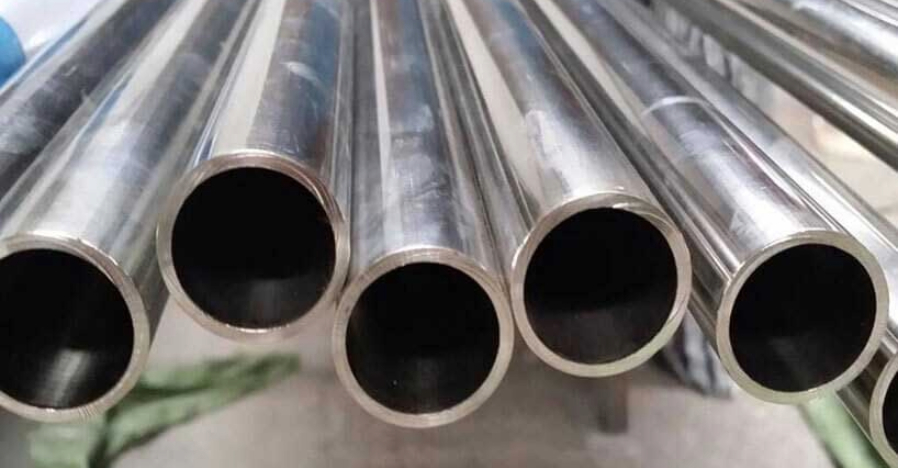
WELDED AND SEAMLESS PIPES
Seamless and welded pipes are two common types of steel pipes used in various industries, each with distinct manufacturing processes and applications. Seamless pipes are produced from a solid round billet that is heated and pierced to form a hollow tube without any welding seams.
This process gives them superior strength and uniformity, making them ideal for high-pressure and high-temperature applications such as in the oil and gas, power generation, and petrochemical sectors. Because they lack a weld seam, seamless pipes generally offer better mechanical properties and structural integrity. However, they are more expensive to produce and have limitations in terms of size and availability. On the other hand, welded pipes are manufactured by rolling metal sheets or plates into a cylindrical shape and welding the edges together. There are several welding methods used, including Electric Resistance Welding (ERW), Longitudinal Submerged Arc Welding (LSAW), and Helical Submerged Arc Welding (HSAW). Welded pipes are more economical and widely available, with the added advantage of being produced in larger diameters and longer lengths compared to seamless pipes. Though they have a visible weld seam, modern welding techniques and heat treatments can enhance their strength and reliability, making them suitable for structural, low-pressure, and general-purpose applications. The choice between seamless and welded pipes ultimately depends on the specific requirements of the application, including pressure ratings, budget, and environmental conditions.
Available Grades of Pipes & Tubes
| Material | Standard | Available Grades | |||||||||
|---|---|---|---|---|---|---|---|---|---|---|---|
| 1 | 2 | 3 | 4 | 5 | 6 | 7 | 8 | 9 | 10 | ||
| Stainless Steel | ASTM A312 / A213 | 304 | 304L | 304H | 309 | 310 | 310S | 316 | 316L | 316Ti | 317L |
| 321 | 321H | 347 | 347H | 410 | 446 | 904L | |||||
| Duplex / Super Duplex | ASTM A790 / A928 | Duplex S31803 / S32205 | Super Duplex S32750 / S32760 | ||||||||
| Nickel Alloys | ASTM B161 / B163 | Nickel 200 | Nickel 201 | Inconel 600 | Inconel 601 | Inconel 625 | Inconel 718 | Incoloy 800 | Incoloy 800HT | Incoloy 825 | |
| Alloy Steel | ASTM A335 / A213 | P5 | P9 | P11 | P12 | P22 | P91 | P92 | |||
| Titanium | ASTM B338 | Gr 1 | Gr 2 | Gr 5 | Gr 9 | ||||||
| Carbon Steel | ASTM A106 / A53 / API 5L | Seamless | ERW | SAW | LSAW | HSAW | API 5L | ||||
| Copper Nickel | ASTM B466 / B467 | CuNi 70/30 | CuNi 90/10 | ||||||||
| Other Alloys | - | SMO 254 | Alloy 28 | 253 MA (S30815) | Alloy 20 | Hastelloy | Aluminium | ||||
Dimensional Standards Table
| Pipe Type | Material & Grade | Dimensions (mm) | Wall Thickness (SCH 40) | Standard | |
|---|---|---|---|---|---|
| Outer Diameter (OD) | Length (L) | ||||
| Seamless Pipe | SS 304/304L/304H | 21.3 | 6000 | 2.77 | ASTM A312 / A213 |
| SS 316/316L/316Ti | 26.7 | 6000 | 2.87 | ||
| SS 321/321H | 33.4 | 6000 | 3.38 | ||
| Welded Pipe | Duplex S31803/S32205 | 42.4 | 6000 | 3.56 | ASTM A790 / A358 |
| Super Duplex S32750/S32760 | 48.3 | 6000 | 3.68 | ||
| Nickel 200/201 | 60.3 | 6000 | 4.78 | ||
| ERW Tube | Alloy Steel P5 | 73.0 | 6000 | 5.16 | ASTM A335 / A691 |
| Alloy Steel P22 | 88.9 | 6000 | 5.49 | ||
| Alloy Steel P91 | 114.3 | 6000 | 6.35 | ||
| EFW Pipe | Inconel 600 | 141.3 | 6000 | 7.11 | ASTM B163 / B705 |
| Monel 400 | 168.3 | 6000 | 7.92 | ||
| Hastelloy C22 | 219.1 | 6000 | 8.74 | ||
Seamless pipes
Seamless pipes and tubes are cylindrical steel products manufactured without any welded joints, offering superior strength, uniformity, and reliability under high pressure and temperature conditions. They are produced from solid round billets that are heated and pierced through the center to form a hollow tube. Common manufacturing methods include rotary piercing, extrusion, and mandrel mill processes, depending on the required size and precision. Because there are no seams, seamless pipes and tubes have uniform mechanical properties throughout, which minimizes the risk of failure under stress. Seamless pipes are widely used for transporting fluids and gases in industries such as oil and gas, petrochemicals, and power generation. Seamless tubes, which are typically made to tighter dimensional tolerances, are often used in applications like heat exchangers, boilers, automotive components, and instrumentation systems. Their high strength, resistance to corrosion and temperature, and precision make seamless pipes and tubes ideal for critical applications across various industrial sectors.
Key Features:
-
1. High Strength: Uniform structure and grain flow enhance strength and durability, making them ideal for high-pressure applications.
-
2. Superior Pressure & Temperature Resistance: Seamless pipes and tubes can withstand extreme pressure and temperature, which is crucial for industries like oil & gas and power generation.
-
3. Smooth Internal Surface: Provides better fluid flow and reduces friction loss in piping systems.
Welded pipes
Welded pipes and tubes are manufactured by bending steel plates or coils into a cylindrical shape and welding the edges together to form a solid structure. This process involves various welding methods, such as Electric Resistance Welding (ERW), High-Frequency Induction Welding (HFIW), and Submerged Arc Welding (SAW), including both Longitudinal (LSAW) and Spiral (HSAW) techniques. After welding, the seam is often heat-treated and inspected to ensure structural integrity. Welded pipes and tubes are widely used in industries such as construction, water supply, chemical processing, and structural applications due to their cost-effectiveness, ease of production, and availability in large sizes and lengths. Although they contain a visible weld seam, modern welding techniques and quality control processes ensure high reliability and strength. They are generally more affordable than seamless pipes and are suitable for low to medium pressure applications where extreme conditions are not a critical concern.
Key Features:
-
1. Visible Weld Seam: Welded along the length or spiral, the seam is usually detectable but can be treated or ground for smoother finishes.
-
2. Cost-Effective Production: Generally cheaper to manufacture than seamless pipes due to simpler processes and less material waste.
-
3. Wide Availability: Easily produced in large quantities, various diameters, wall thicknesses, and lengths—suitable for both standard and custom orders.
-
4. Good Dimensional Accuracy: Offers consistent diameter and wall thickness, especially in Electric Resistance Welded (ERW) pipes.

