
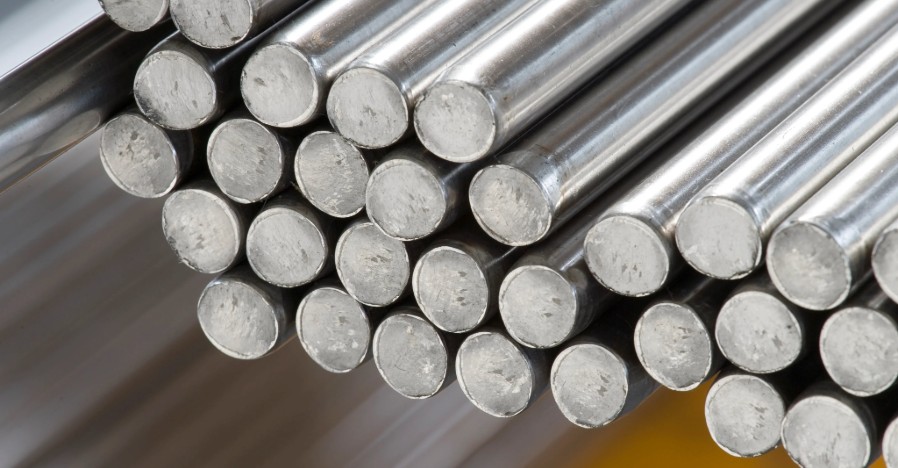
BAR
Our extensive inventory includes Bright Bars, Forged Bars, and Rectangular Bars, available in various grades, sizes, and specifications to suit diverse industrial needs. Whether you require Stainless Steel, Duplex & Super Duplex, Inconel, Monel, Nickel, Hastelloy, Alloy Steel, Alloy 20, Brass, Tantalum, Copper Nickel, Carbon Steel, or Titanium, we offer solutions that meet international quality standards, ensuring high performance in demanding environments.
Manufactured using premium-quality materials, our bars are designed for superior corrosion resistance, high tensile strength, and excellent mechanical properties. We offer customization options, allowing customers to choose between matte, mirror, or silver finishes based on their specific project requirements. Each product undergoes strict quality control and precision engineering to ensure durability, reliability, and long-term performance.Designed for critical industrial applications, our bars support industries such as Oil & Gas, Construction, Chemical Processing, Power Generation, Aerospace, Automotive, Pharmaceuticals, and Heavy-Duty Engineering. Whether used for structural frameworks, machining components, industrial fittings, or manufacturing equipment, our products offer high-strength, wear-resistant, and corrosion-proof solutions.
Available Grades of Bars - Round, Flat & Hex
| Material | Standard | Available Grades | |||||||||
|---|---|---|---|---|---|---|---|---|---|---|---|
| 1 | 2 | 3 | 4 | 5 | 6 | 7 | 8 | 9 | 10 | ||
| Stainless Steel | ASTM A276 / A479 | 304 | 304L | 304H | 309 | 310 | 310S | 316 | 316L | 316Ti | 317L |
| 321 | 321H | 347 | 347H | 410 | 420 | 430 | 446 | 904L | |||
| Duplex / Super Duplex | ASTM A276 / A479 | Duplex S31803 / S32205 | Super Duplex S32750 / S32760 | ||||||||
| Nickel Alloys | ASTM B160 / B164 | Nickel 200 | Nickel 201 | Inconel 600 | Inconel 625 | Inconel 718 | Incoloy 800 | Incoloy 825 | Monel 400 | Monel K500 | |
| Alloy Steel | ASTM A182 / A336 | F1 | F5 | F9 | F11 | F12 | F22 | F91 | F92 | ||
| Titanium | ASTM B348 | Gr 1 | Gr 2 | Gr 5 | Gr 9 | ||||||
| Carbon Steel | ASTM A36 / A105 | Mild Steel | High Tensile | S355J2+N | ST 52 | EN 353 | |||||
| Copper Nickel | ASTM B151 | CuNi 70/30 | CuNi 90/10 | ||||||||
| Other Alloys | - | Alloy 20 | Hastelloy | Brass | Beryllium Copper | Tantalum | SMO 254 | Aluminium | |||
Dimensional Standards Table
| Bar Type | Shape | Size Range (mm) | Length (mm) | Standard |
|---|---|---|---|---|
| Round Bar | Bright Bar | 3mm - 100mm | 3000 - 6000 | ASTM A276 / A479 |
| Forged Bar | 100mm - 600mm | Up to 9000 | ||
| Hex Bar | Hexagonal | 8mm - 60mm | 3000 - 6000 | ASTM A276 |
| Flat Bar | Rectangular | 20mm - 200mm Width | 3000 - 6000 | ASTM A276 |
| Square Bar | Square | 10mm - 150mm | 3000 - 6000 | ASTM A276 |
| Rectangular Bar | Rectangular | 10mm - 100mm Width | 3000 - 6000 | ASTM A276 |
Square Bar
A square bar is a solid metal bar with a square cross-sectional shape, widely used in construction, engineering, manufacturing, and fabrication applications. It offers high structural integrity and is commonly used for support frameworks, braces, shafts, fencing, gates, and ornamental work. Square bars are available in various materials, including mild steel, stainless steel, aluminum, brass, and alloy steel, depending on the required strength, corrosion resistance, and application environment. Due to its uniform shape and sharp edges, a square bar provides excellent balance and rigidity, making it suitable for machining, welding, and forming processes.
Key Features:
-
1. Uniform Square Cross-Section: Provides consistent strength and rigidity along the entire length.
-
2. High Structural Integrity: Suitable for load-bearing, support frameworks, and structural applications.
-
3. Easy to Machine and Fabricate: Ideal for cutting, welding, bending, and forming into various shapes.
-
4. Wide Range of Sizes: Offered in multiple thicknesses and lengths to meet diverse project requirements.
-
5. Corrosion Resistance Options: Available in stainless steel or coated materials for durability in harsh environments.
Hex bar
A hex bar, also known as a hexagonal bar or hexagonal rod, is a solid metal bar with a six-sided cross-section widely used in manufacturing, construction, and machining industries. Its unique hexagonal shape provides excellent grip and surface area, making it ideal for fasteners, shafts, pins, and tooling components where torque transmission and wrenching capability are important. Hex bars are typically made from materials such as carbon steel, stainless steel, alloy steel, and brass, chosen based on strength, corrosion resistance, and application needs. They are available in various sizes and lengths and can be easily machined, drilled, or threaded to meet specific engineering requirements. Hex bars comply with industry standards like ASTM, DIN, and ISO to ensure quality and consistency. Their combination of strength, durability, and versatility makes hex bars essential components in automotive, aerospace, heavy machinery, and general fabrication projects.
Key Features:
-
1. Hexagonal Cross-Section: Provides excellent grip and allows easy wrenching and torque application.
-
2. High Strength and Durability: Suitable for heavy-duty applications requiring toughness and wear resistance.
-
3. Machinability: Easily drilled, threaded, and machined to create custom parts like fasteners, shafts, and pins.
-
4. Wide Range of Sizes: Available in multiple diameters and lengths for versatile use.
-
5. Corrosion Resistance Options: Available in stainless steel or coated forms for protection in harsh environments.
Rectangular Bar
A rectangular bar is a solid metal bar with a rectangular cross-section, commonly used in construction, manufacturing, and structural applications due to its strength and versatility. Its flat surfaces and right-angled edges make it ideal for use in frameworks, supports, braces, machinery components, and architectural features where stability and load-bearing capacity are critical. Rectangular bars are available in various materials such as mild steel, stainless steel, aluminum, brass, and alloy steel, selected based on factors like strength requirements, corrosion resistance, and weight considerations. They can be easily cut, welded, machined, or bent to suit specific project needs. Manufactured to meet industry standards such as ASTM, ISO, and EN, rectangular bars come in a range of sizes and thicknesses to accommodate different design specifications.
Key Features:
-
1. Rectangular Cross-Section: Provides flat, stable surfaces with sharp edges for structural integrity and easy alignment.
-
2. High Load-Bearing Capacity: Suitable for structural applications where strength and support are essential.
-
3. Easy to Fabricate: Can be cut, drilled, welded, bent, or machined to meet custom project needs.
-
4. Corrosion Resistance Options: Offered in corrosion-resistant materials or coated for long-term durability in harsh conditions.
-
5. Wide Range of Sizes: Available in multiple widths, thicknesses, and lengths to suit diverse applications.
Flat Bar
A flat bar is a solid metal strip with a rectangular cross-section and uniform thickness, widely used in structural, fabrication, and general-purpose applications. Its flat, straight shape makes it ideal for use in support structures, frames, braces, gates, grills, and reinforcements, as well as in manufacturing components for machinery and construction. Flat bars are available in various materials such as mild steel, stainless steel, aluminum, brass, and alloy steel, chosen based on required strength, corrosion resistance, and application environment. These bars are known for their ease of machining, welding, cutting, and bending, which makes them highly versatile and suitable for both heavy-duty industrial use and decorative architectural work.
Key Features:
-
1. High Strength: Offers excellent load-bearing capacity for structural and support applications.
-
2. Easy to Fabricate: Simple to cut, drill, weld, bend, or machine, making it ideal for custom fabrication.
-
3. Corrosion Resistance Options: Available in corrosion-resistant grades or coated finishes for long-term durability.
-
4. Wide Range of Sizes: Offered in various widths, thicknesses, and lengths to fit diverse project requirements.
-
5. Cost-Effective: Provides a reliable and economical solution for structural and fabrication needs.
Bright Bar
A bright bar is a highly finished, cold-drawn metal bar with a smooth, bright surface and precise dimensional tolerances, commonly used in applications requiring accuracy, strength, and a polished appearance. Unlike hot-rolled bars, bright bars are produced through cold finishing processes such as drawing, grinding, or polishing, which enhance surface quality, improve mechanical properties, and ensure tight dimensional control. They are available in various shapes including round, square, hexagonal, and flat, and are made from materials like mild steel, stainless steel, alloy steel, and carbon steel depending on the application requirements. Bright bars are widely used in industries such as automotive, construction, engineering, machining, fabrication, and tool manufacturing, particularly where high precision and aesthetic finish are important.
Key Features:
-
1. Smooth Surface Finish: Cold drawn or polished for a bright, clean, and visually appealing surface.
-
2. Tight Dimensional Tolerances: Manufactured with high precision, ideal for applications requiring exact sizes.
-
3. High Strength and Hardness: Cold working enhances mechanical properties like tensile strength and surface hardness.
-
4. Excellent Machinability: Suitable for precision machining and fabrication without additional surface preparation.
-
5. Corrosion Resistance: Stainless and coated variants offer improved resistance in harsh environments.
Rivets
A forged bar is a solid metal bar produced through the forging process, which involves applying compressive forces to shape the metal—typically using hammers or presses—while it is heated to high temperatures. This process refines the grain structure of the metal, eliminates internal voids, and significantly improves the bar's mechanical properties, including strength, toughness, and fatigue resistance. Forged bars are available in various shapes such as round, square, rectangular, and hexagonal, and are commonly made from materials like carbon steel, alloy steel, stainless steel, tool steel, and titanium, depending on the application. They are widely used in heavy-duty industrial applications, including aerospace, oil and gas, power generation, automotive, marine, and heavy machinery, where superior structural integrity and performance under stress are essential.
Key Features:
-
1. Superior Strength: Enhanced mechanical strength due to refined grain structure from the forging process.
-
2. High Toughness and Fatigue Resistance: Excellent performance under heavy loads, impact, and cyclic stress.
-
3. Improved Structural Integrity: Forging reduces internal defects such as porosity and voids.
-
4. Heat Treatable: Can be heat treated for additional hardness, strength, or wear resistance.
-
5. Dimensional Accuracy: Forging provides better dimensional control compared to casting.

