
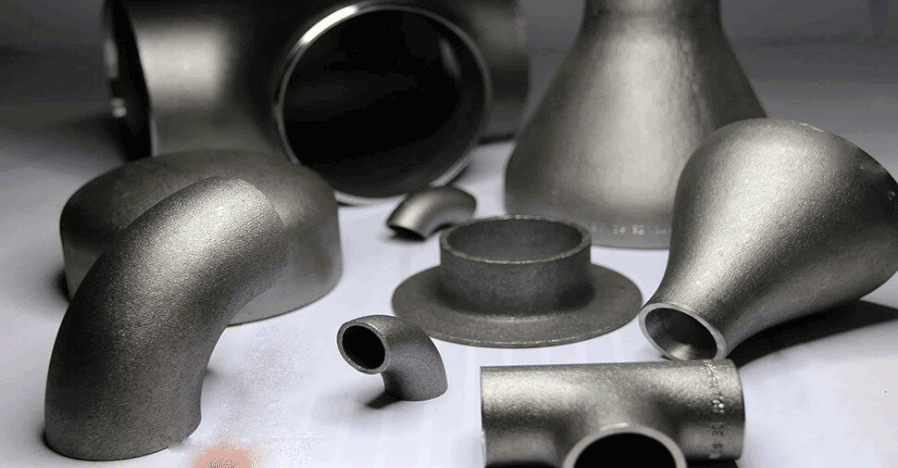
Buttweld Fitting
A buttweld fitting is a weldable pipe fitting that allows for change of direction of flow, to branch off, reduce pipe size or attach auxiliary equipment. Forged Steel buttweld fittings are manufactured in accordance with ANSI / ASME B16.9.
Butt weld fittings are available as elbows, tees, caps, cross, reducers bend etc. These fittings are the most common type of welded pipe fitting and are specified by nominal pipe size and pipe schedule. Buttweld fittings use seamless or welded pipe as the starting material and are formed (through multiple processes) to get the shape of elbows, tees and reducers etc. Just as the pipe is sold from Schedule 10 to Schedule 160, butt weld pipe fittings are sold the same way. Welded butt weld fittings are more common in stainless steel due to cost advantage. Sch. 10 fittings are also more common in stainless steel butt weld fitting.
Available Grades of Buttweld Fittings
| Material | Standard | Available Grades | |||||||||
|---|---|---|---|---|---|---|---|---|---|---|---|
| 1 | 2 | 3 | 4 | 5 | 6 | 7 | 8 | 9 | 10 | ||
| Stainless Steel | ASTM A403 WP | 304 | 304H | 309 | 310 | 316 | 316L | 317L | 321 | 347 | 904L |
| Alloy Steel | ASTM / ASME A/SA 234 | WP1 | WP11 | WP12 | WP22 | WP91 | WP5 | WP9 | |||
| Carbon Steel | ASTM A234 | WPB | WPBW | WPHY 42 | WPHY 46 | WPHY 52 | WPHY 60 | WPHY 65 | WPHY 70 | ||
| High Nickel Alloys | ASTM B163 / B333 / B622 | Nickel 200 | Nickel 201 | Alloy 20 | Incoloy 800 | Incoloy 825 | Monel 400 | Monel K500 | Hastelloy C276 | Hastelloy C22 | |
| Titanium | ASTM B348 / B381 | Grade 1 | Grade 2 | Grade 5 | Grade 7 | ||||||
| Monel | ASTM B564 / B865 | Monel 400 | Monel K500 | ||||||||
| Hastelloy | ASTM B622 / B619 | C22 | C276 | B2 | Hastelloy X | ||||||
| Duplex & Super Duplex | ASTM A815 / ASME SA 815 | Duplex 2205 | Duplex 2304 | Super Duplex 2507 | |||||||
| Inconel | ASTM B163 / B167 / B564 | 600 | 601 | 625 | 718 | 800 | 825 | ||||
| Aluminum | ASTM B209 / B221 | 1100 | 2011 | 2014 | 2024 | 3003 | 5052 | 6061 | 6063 | 7075 | |
Buttweld Elbow (90°, 45°, 180°, Male/Female)
An elbow is a type of buttweld pipe fitting used to change the direction of flow in a pipeline. The most common types are 90-degree, 45-degree, and 180-degree elbows, which allow for various directional changes. Additionally, male and female elbows are used for specific joint connections. These fittings ensure smooth fluid flow and are commonly used in industries such as oil & gas, petrochemicals, and power plants.
Key Features:
-
1. Available in different angles (90°, 45°, 180°) to suit various piping layouts.
-
2. Designed for seamless or welded applications.
-
3. Manufactured in materials like stainless steel, carbon steel, alloy steel, and duplex steel.
-
4. Provides excellent resistance to corrosion and high-pressure environments.
-
5. Male and Female Elbows are used for threaded connections in certain applications.
Buttweld Tee (Equal Tee, Reducing Outlet Tee)
A tee is a buttweld pipe fitting used to combine or split the flow of fluids in a pipeline. It has three openings – one inlet and two outlets at 90° angles to the main line. There are two main types: Equal Tee, where all three outlets have the same diameter, and Reducing Outlet Tee, where one branch outlet has a smaller diameter than the main pipe. These fittings are widely used in plumbing, chemical, oil & gas, and water distribution applications.
Key Features:
-
1. Available in Equal and Reducing configurations for different piping needs.
-
2. Used for distributing or collecting fluid flow in various applications.
-
3. Manufactured in Stainless Steel, Carbon Steel, Alloy Steel, and Duplex Steel.
-
4. Complies with ASME B16.9 standards for industrial use.
-
5. Available in seamless and welded forms.
Buttweld Cross (Equal Cross, Reducing Cross)
A Cross is a buttweld pipe fitting used where four pipes meet at a common junction. It has one inlet and three outlets (or vice versa) positioned at 90° angles to each other. The two main types include Equal Cross, where all four ends have the same diameter, and Reducing Cross, where one or more branch outlets have a smaller diameter than the main line. Cross fittings are widely used in fire sprinkler systems, chemical processing plants, and high-pressure applications.
Key Features:
-
1. Used for multi-directional fluid distribution in piping networks.
-
2. Available in Equal and Reducing configurations for different applications.
-
3. Manufactured using Stainless Steel, Carbon Steel, Alloy Steel, and Duplex Steel.
-
4. Complies with ASME B16.9 and MSS SP-75 standards.
-
5. Suitable for high-pressure and high-temperature environments.
Buttweld Cap (Pipe End Cap)
A Pipe Cap is a buttweld fitting used to close the end of a pipe, stopping the flow of fluids or gases. It protects pipe ends from damage, contaminants, and environmental exposure. Caps are commonly used in plumbing, industrial piping, and high-pressure applications to provide a secure, leak-proof seal.
Key Features:
-
1. Seals the end of pipes in both permanent and temporary applications.
-
2. Available in various materials like Stainless Steel, Carbon Steel, Alloy Steel, and Duplex Steel.
-
3. Designed for high-pressure and high-temperature environments.
-
4. Manufactured according to ASME B16.9, MSS SP-75, and DIN standards.
-
5. Smooth, rounded shape to reduce stress concentration.
Buttweld Stub End (Lap-Joint Stub End)
A stub end is a short pipe fitting used in combination with a lap joint flange to create a flanged connection that allows easy dismantling and rotation. It is commonly used in systems that require frequent disassembly for maintenance or alignment adjustments. Lap-Joint Stub End is a specific subtype designed to work with a lap joint flange. It provides flexibility in pipe alignment and reduces the stress on bolts, making it ideal for low-pressure and non-critical applications.
Key Features:
-
1. Used with a lap joint flange to allow easy pipeline dismantling.
-
2. Helps in pipeline alignment adjustments and reduces flange bolt stress.
-
3. Available in different materials, including stainless steel, carbon steel, and alloy steel.
-
4. Lap-Joint Stub End is ideal for low-pressure and non-critical applications.
-
5. Manufactured in different lengths (short & long pattern) as per ASME B16.9.
Buttweld Swage Nipple
A swage nipple is a type of pipe fitting used to connect pipes of different diameters. It is a reducer that is typically used in high-pressure applications in the oil, gas, and petrochemical industries. Swage nipples are designed with a smaller end and a larger end, allowing for a smooth transition between pipes of varying sizes. They are usually made from carbon steel, stainless steel, or alloy steel, and are available in both threaded and beveled end configurations to suit welding or screw connections. These fittings come in concentric and eccentric types—concentric swage nipples keep the pipe centerlines aligned, while eccentric swage nipples offset the centerlines, which is helpful in maintaining a consistent bottom-of-pipe level for drainage or flow purposes. They are manufactured to meet standards such as ASTM, ASME, and ANSI, ensuring durability and pressure resistance in demanding environments.
Key Features:
-
1. Size Reduction: Connects pipes of different diameters, acting as a reducer.
-
2. End Connections: Comes with threaded, plain, or beveled ends for welding or screwing.
-
3. Pressure Rating: Suitable for high-pressure applications, often used in oil, gas, and petrochemical industries.
-
4. Durability: Engineered for long service life in harsh environments.
-
5. Standards Compliance: Manufactured to industry standards like ASTM, ASME, and ANSI.
Buttweld Reducer
A reducer buttweld fitting is a pipe fitting used to join two pipes of different diameters by welding, ensuring a secure and leak-proof connection. It is designed to create a smooth transition in flow between the larger and smaller pipe sizes, reducing turbulence and pressure loss within the system. Commonly used in industries such as oil and gas, petrochemical, power generation, and water treatment, reducer buttweld fittings are available in two main types: concentric reducers, which align the centerlines of both pipes and are ideal for vertical installations, and eccentric reducers, which have an offset centerline and are preferred in horizontal piping to maintain consistent bottom levels and prevent air accumulation.
Key Features:
-
1. Seamless or Welded Construction for high strength and leak-proof connections.
-
2. Standard Compliance: Typically manufactured according to ASME B16.9, ASTM, or MSS SP standards.
-
3. Pressure and Temperature Resistance: Suitable for high-pressure and high-temperature applications.
-
4. Corrosion Resistance: Depending on material, provides excellent resistance to corrosion and chemical exposure.
-
5. Smooth Flow Transition: Reduces flow disturbances and erosion caused by abrupt changes in diameter.
Buttweld Coupling
A coupling is a type of pipe fitting used to connect two pieces of pipe in a straight line, typically of the same diameter, allowing for continuous flow within a piping system. It plays a crucial role in both extending pipe runs and repairing broken or damaged sections. Couplings are widely used across various industries such as plumbing, oil and gas, chemical processing, and water supply systems. They come in different types, including full couplings (which connect two pipes completely), half couplings (which connect a pipe to a fitting or piece of equipment), and reducing couplings (used to connect pipes of different diameters). Couplings can have threaded, socket-welded, or plain ends depending on the method of connection, such as screwing or welding. Made from materials like carbon steel, stainless steel, brass, or PVC, they are designed to match the application’s pressure, temperature, and corrosion-resistance requirements. Couplings are essential for efficient and safe pipeline assembly, offering flexibility, ease of installation, and structural integrity.
Key Features:
-
1. Pipe Connection: Joins two pipes in a straight line, either permanently or for maintenance access.
-
2. End Connections: Offered with threaded, socket-weld, or plain ends to suit different joining methods.
-
3. Size Compatibility: Available for both equal-sized and different-sized pipe connections.
-
4. Durability: Provides strong, leak-proof connections, even under high pressure and temperature conditions.
-
5. Corrosion Resistance: Suitable for corrosive environments, depending on the material used.

